The Artificial Leaf
An academic–industry innovation programme run on SUGAR’s Triple Diamond, with a six-person team of students from the University of Bologna and the Université Côte d’Azur. I was hired by the Innovation Centre for Entrepreneurship. The Istituto Italiano di Tecnologia was the client.
A technology with no market yet
An artificial photosynthesis system turning CO₂ into carbon monoxide, formic acid, methanol, ethanol and ethylene using solar energy. Built at lab scale, with no market.
Find it a business opportunity. Six students across service design, engineering, architecture, economics and education, over nine months.
What the institute asked for
How might we develop an innovative service based on the “Artificial photosynthesis technology” and create a business opportunity out of it?
Nine months, three diamonds, three cities. The answer we delivered was a different question.
Three diamonds, diverge and converge each time
Desk research across nine fields, case studies of comparable technologies, expert interviews, personas.
Plastics taken forward. Critical experience prototypes, then dark horse and funky prototypes, then one merged functional system.
The challenge turned around. Design vision, solution, brand and interface, built and tested against a real case.
Nine fields, narrowed twice
The technology turns CO₂ into carbon monoxide, formic acid, methanol, ethanol and ethylene, which means almost any heavy-emitting sector is arguably a candidate. Narrowing it took two passes.
Desirability, technical feasibility, economic viability. Used to contextualise each application and pick the three most promising sectors to research in depth.
Efficiency. Space the technology needs. Amount of waste produced. Feasibility. Subsidy. Filtration system. Cutting pollution and using the derived chemicals at once. Future relevance.
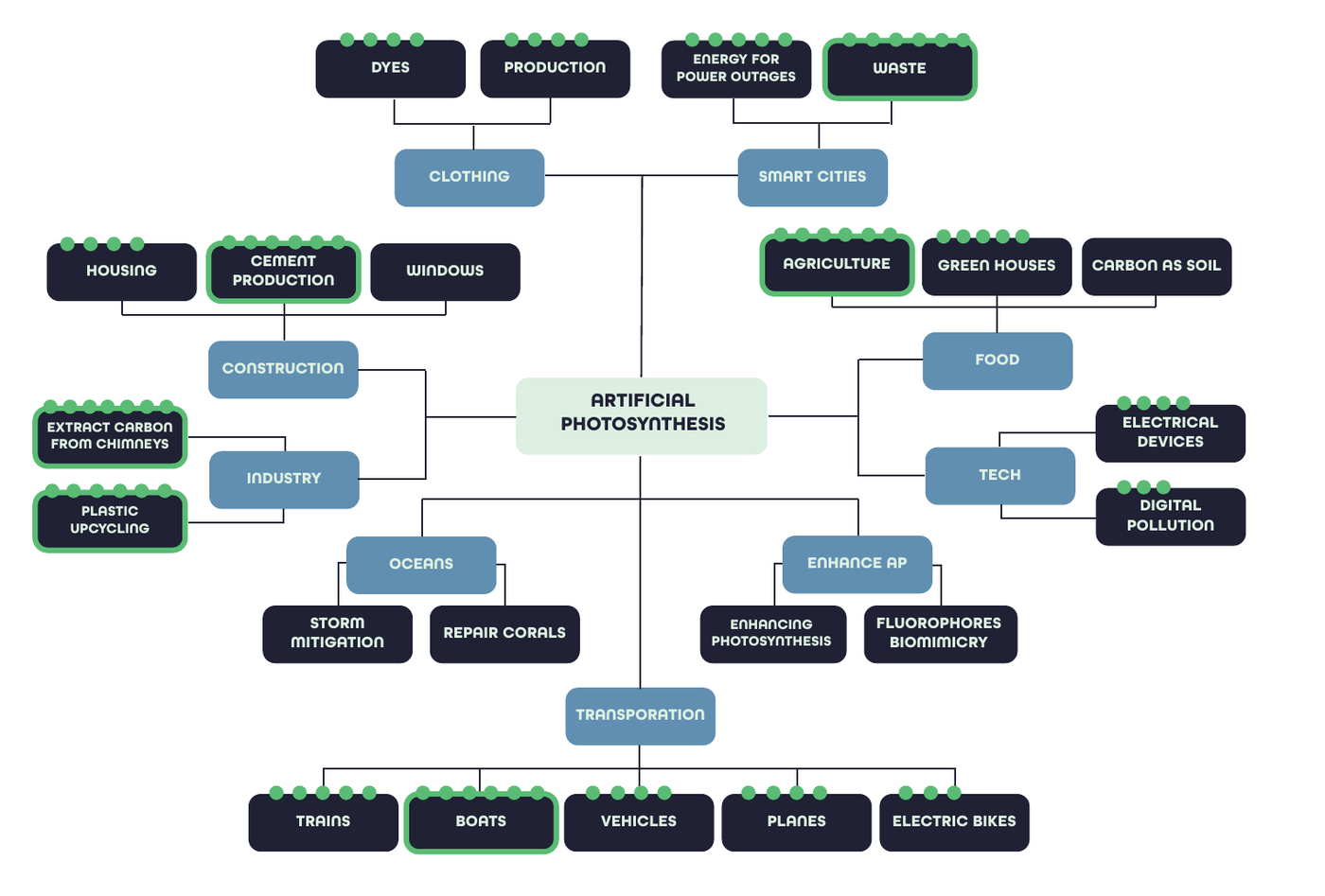
The criteria went onto a mind map of every application we had found, and the team voted on it directly. Plastics upcycling was taken forward.
- Chimneys
- Cement production
- Fashion
- Building sector
- Transportation
- Plastic upcycling
- Agriculture
- Digital pollution
- Waste sector
A persona, and the question it opens
Personas were built from the interviews with companies, experts and researchers, one per sector. Each one ends in a “how might we” question, which is what the next phase prototypes against.
Sebastiàn
Carbon capture lead in a cement production factory. Environmental engineer in southwest France, working on solutions to climate change. Calls himself a navigator, runs, skis.
Frustrations
Subsidies, and a government doing too little in power generation.
- Turn carbon dioxide into an opportunity, and avoid the fees.
- Keep productivity and efficiency running around the clock.
- Work inside an ecosystem.
- Be an industrial leader in the energy transition.
How might we help Sebastiàn use the artificial leaf to intervene with carbon dioxide storage during the production of cement, in order to add value to it?
The deadlock underneath
We had plastics, months of research behind it and prototypes tested against it. Reaching out to companies is where the pattern showed up. The technology is so customisable that defining a valuable application meant involving a company in designing it, and no company would engage at that stage.
Need companies to invest so the technology can be developed further.
Need the technology developed further before they are comfortable investing.
The problem was not finding an application for the leaf. It was getting companies to understand its value while it was still early. We rewrote the challenge:
How might we create a reliable system around the artificial leaf technology during its development phase in order to onboard companies?
CO/LAB, an onboarding tool for a technology that is not finished
Software that simulates installing the leaf in a specific factory, so the institute and a company can work through the technical, physical and financial logistics together, on editable templates, in the same room. It states plainly that the technology has a low readiness level, and pairs that with the projections a company needs in order to invest anyway.
The company enters its CO₂ emissions, its emissions taxes, the space it has and the output it wants.
Location and desired output volume produce a detailed simulation.
A benefits evaluation and a costs-and-benefits analysis built from what they entered.
How much space the installation takes and what infrastructure it needs. Specified, and left as the next build.
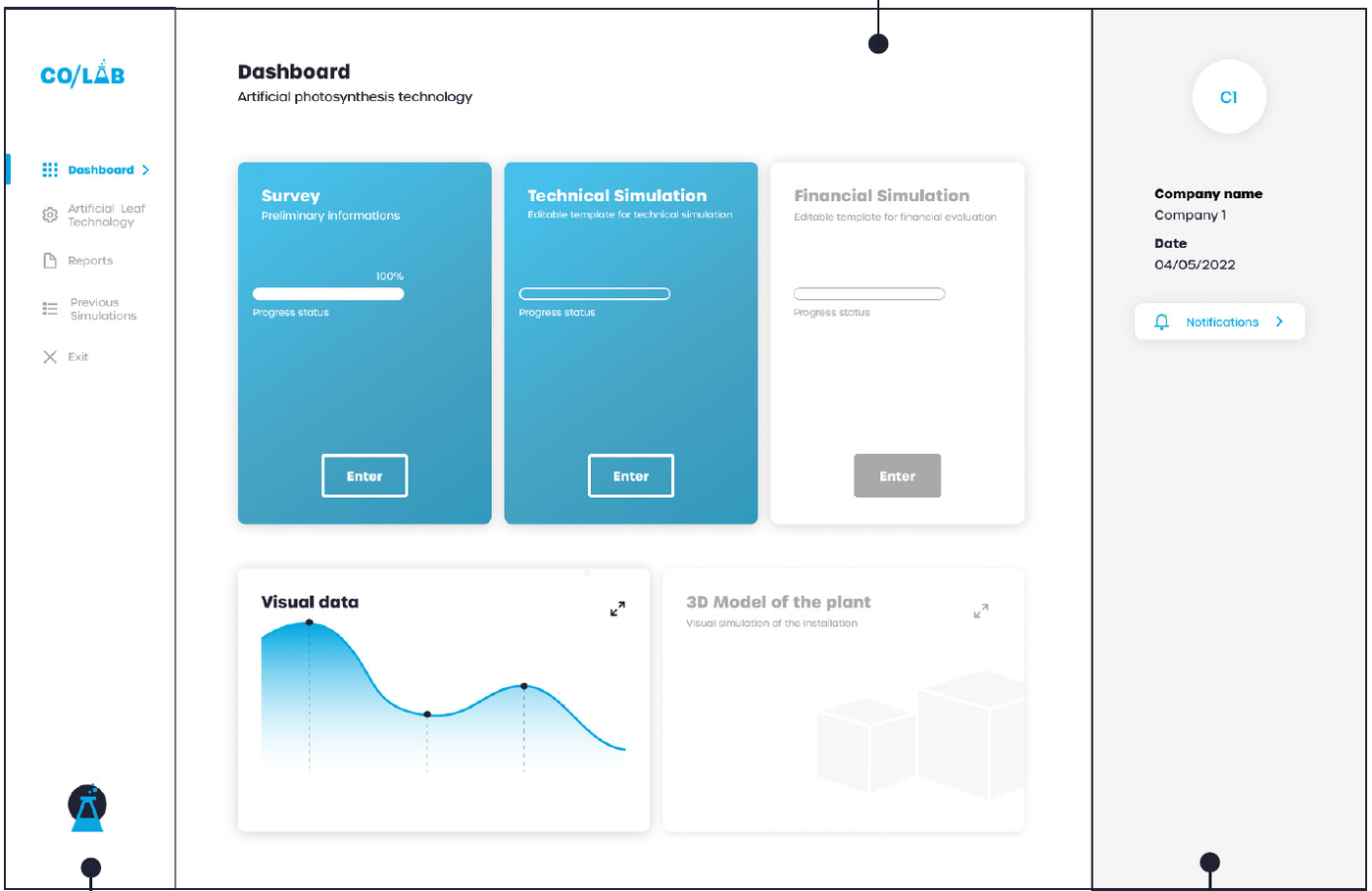
The parts that mattered most were the ones around the software. Questions the scientists were answering over and over got compiled in one place. Meetings got a structure that survived a company’s questions. Each session left an automatic record, and the company left with a printed report to plan from.
How it ran
- Oct 2021 · NiceGlobal kickoff. The team meets.
- Nov 2021Needfinding. Desk research, case studies, expert interviews, personas.
- Dec 2021Plastics selected as the application. A critical experience prototype built against it. Fall presentation.
- Jan 2022Plastic industry research. Dark horse and funky prototypes, developed and tested.
- Feb 2022The prototypes merged into one functional system prototype.
- Mar 2022 · BolognaThe u-turn. Away from plastics, toward science communication and onboarding for technology transfer.
- Apr 2022 · TurinDesign principles and design vision. Winter presentation.
- May 2022Both ends of the solution built: the interface and what sits behind it.
- Jun 2022 · San FranciscoCO/LAB presented at the SUGAR Expo.